Clean Label Project Cat Food Study: Is Your Cat’s Food Safe? Recall Updates, Royal Canin, Fancy Feast, and More

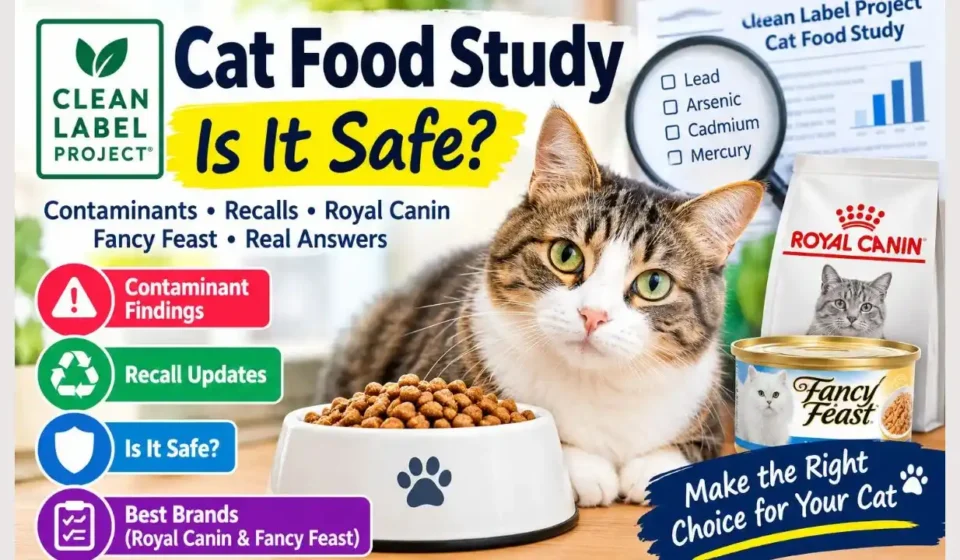
Choosing the right cat food can feel overwhelming when you see headlines about heavy metals, chemical contaminants, and pet food safety. If you have searched for the Clean Label Project cat food study, you may be wondering whether your cat’s favorite food is safe, whether a recall has been announced, and which brands deserve your trust.
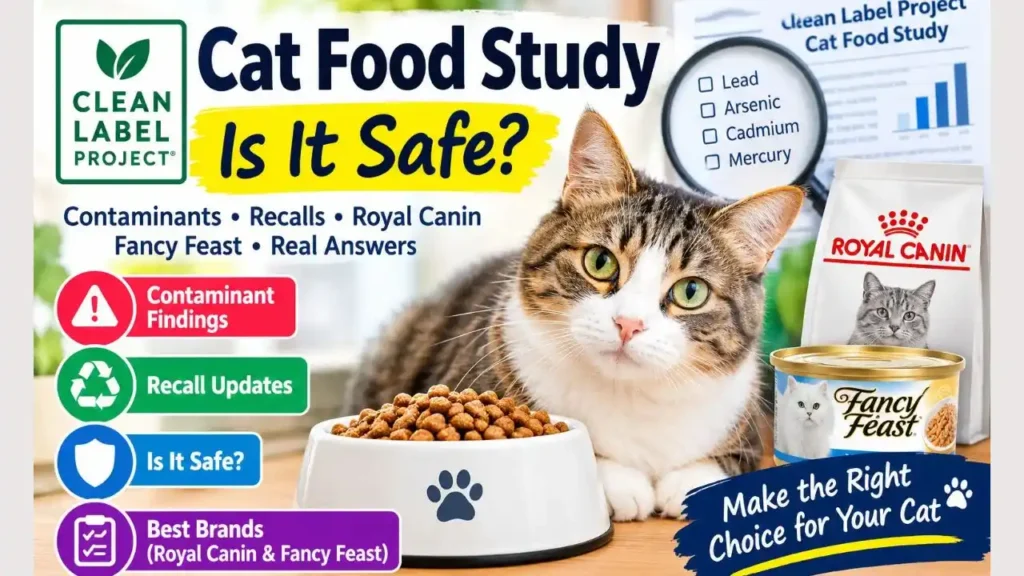
The Clean Label Project (CLP) published a cat food study on October 2, 2026, examining 100 products from 62 brands for more than 122 contaminants. Its findings have raised questions about lead, arsenic, cadmium, mercury, and other substances in commercial cat food.
However, detecting a contaminant does not automatically mean a food is unsafe. Understanding the study, its limitations, and official recall information can help you make a more informed decision for your cat.
In this guide, we explain the Clean Label Project cat food study, explore Royal Canin and Fancy Feast, discuss online and Reddit concerns, and share practical steps for choosing cat food in the United States.
What Is the Clean Label Project Cat Food Study?
The Clean Label Project is a nonprofit organization that evaluates consumer products for contaminants and publishes research intended to improve product transparency.
Its 2026 cat food study investigated 100 cat food products representing 62 brands. According to the organization’s published findings, an independent laboratory tested the samples for more than 122 industrial and environmental contaminants.
The investigation examined substances including heavy metals, pesticide residues, plastic-related chemicals, and other contaminants. The goal was to compare the products and identify those with lower overall contaminant levels.
The study is particularly relevant to cats because many households feed their pets the same food every day for months or years.
However, the study is not the same as a government recall notice, and its rankings do not independently establish whether a particular food will cause illness.
What Did the Clean Label Project Cat Food Study Find?
The Clean Label Project reported several notable findings in its October 2026 publication.
| Study finding | What it means for cat owners |
|---|---|
| Lead was detected in 99% of tested products. | Detection alone does not establish a harmful dose or prove that a product violates regulations. |
| Cadmium was detected in 96% of products. | Results need to be interpreted alongside concentration and exposure information. |
| Arsenic was detected in 94% of products. | The form of arsenic and the amount present matter when assessing risk. |
| Fish- and seafood-based foods had about 18 times the mercury levels of other foods. | Comparing protein sources may be worthwhile, especially when fish is your cat’s only food. |
| Dry food had about three times the lead levels of wet or air-dried food in the study. | This was a comparison among the tested samples, not proof that every dry food contains more lead. |
| Poultry-based foods more frequently met CLP’s protein-related standard than fish-based foods. | The result reflects the organization’s evaluation criteria, not a complete nutritional assessment of every brand. |
Source: Clean Label Project’s 2026 cat food study and published study summary.
These findings deserve attention, but they require careful interpretation. The presence of a chemical is not the same as evidence of poisoning. Risk depends on the concentration, the chemical form, the amount eaten, the frequency of exposure, and the animal’s characteristics.
The study also represents a limited set of product samples. It should not be interpreted as a measurement of every recipe, production lot, or can sold in America.
Is Clean Label Project Cat Food Safe?
The short answer is that the Clean Label Project study alone cannot determine whether every tested cat food is safe or unsafe.
The study identifies contaminants and compares products using the organization’s evaluation standards. It does not automatically establish that every product with a detected contaminant poses a health risk.
When evaluating cat food safety, consider three important factors:
1. The amount of the contaminant
A substance detected at a very low concentration may present a different risk from the same substance found at a much higher concentration.
2. Your cat’s total exposure
A cat’s exposure depends on how much food it eats, how frequently it eats it, and whether the same contaminant appears in other foods or treats.
3. The relevant safety standards
A private organization’s purity criteria are not necessarily equivalent to government regulations or a veterinary toxicology assessment.
The Pet Food Institute, an industry trade association, criticized the study’s interpretation because it said the findings lacked important regulatory and scientific context. This is a relevant counterpoint when evaluating the report, although it does not replace independent assessment of the underlying data.
For a practical approach, choose a nutritionally complete food appropriate for your cat’s life stage, check current recall notices, and ask your veterinarian about any specific concerns.
Clean Label Project Cat Food Recall: Has a Recall Been Announced?
One of the most common questions is whether the Clean Label Project cat food study triggered a cat food recall.
A study finding is not automatically a recall. Testing may identify substances that require further investigation, but an official recall involves a separate action by a manufacturer or regulatory authority.
To check whether a cat food has been recalled in the United States, consult the U.S. Food and Drug Administration (FDA).
Official resource: https://www.fda.gov/animal-veterinary/safety-health/recalls-withdrawals
When checking a recall, look for:
- The exact brand and product name.
- The specific recipe or product variety.
- Lot codes and UPC numbers.
- Best-by or expiration dates.
- The stated reason for the recall.
- Instructions from the manufacturer or FDA.
Do not rely only on a social media post saying that a brand has been recalled. A notice may apply to a specific product or lot rather than the entire brand.
The FDA’s recall database changes over time, so check the official notice before purchasing a product or feeding a potentially affected package to your cat.
If your cat has eaten a product included in an active recall, follow the notice’s instructions and contact your veterinarian if your cat shows signs of illness.
Clean Label Project Cat Food Safe List: How to Find Better-Ranked Products
Many cat owners search for a Clean Label Project cat food safe list because they want to know which products tested better.
The organization publishes a list called the Clean Sixteen, which highlights 16 products with the lowest overall contaminant levels in the category it tested.
You can review the organization’s published results here:
Keep in mind that the Clean Sixteen is a comparative ranking, not a universal list of foods guaranteed to be safe.
A product missing from the list has not necessarily failed a legal safety standard. It may not have been included in the study, or it may not have ranked among the 16 products with the lowest overall contaminant levels.
Before selecting a food, compare these factors:
- Whether the food is labeled complete and balanced for your cat’s life stage.
- Whether the exact recipe appears in the study results.
- Whether current recall notices affect that product.
- Whether the recipe meets your cat’s medical and nutritional needs.
- Whether the manufacturer provides useful quality-control information.
A lower contaminant ranking can be one consideration, but it should not be your only reason for choosing a cat food.
Clean Label Project Cat Food and Royal Canin
Royal Canin is frequently discussed in searches about cat food safety because many cat owners use its everyday, breed-specific, and veterinary diets.
The Clean Label Project’s published tested-products information includes Royal Canin Adult Instinctive Loaf in Sauce. However, the presence of a product in the study does not mean that the entire Royal Canin brand has been declared unsafe.
It is also important to distinguish between being tested and appearing on the Clean Sixteen list. These are not interchangeable results.
Should You Stop Feeding Royal Canin?
The study alone is not sufficient reason to conclude that you must stop feeding Royal Canin.
If your cat eats a Royal Canin diet recommended for a specific medical condition, consult your veterinarian before changing foods. An abrupt change may interfere with a carefully managed nutritional plan.
Instead, check the exact recipe against the study’s published information and the FDA’s current recall notices. Consider your cat’s age, health, appetite, and nutritional requirements before making a change.
A food’s overall quality cannot be judged solely by its ingredient list or by whether it appears in one contaminant-ranking study.
Clean Label Project Cat Food and Fancy Feast
Fancy Feast is another popular brand that cat owners search for when reviewing the Clean Label Project findings.
The organization’s published tested-products list includes several Fancy Feast Petites varieties, including Grilled Chicken Entree with Rice, Ocean Whitefish with Tomato, and Seared Salmon Entree with Spinach.
The exact variety matters. Different recipes may have different ingredients, nutrient profiles, and contaminant results.
Is Fancy Feast Safe for Cats?
The Clean Label Project findings do not justify declaring every Fancy Feast product either safe or unsafe.
To evaluate your cat’s food, confirm that the specific product is labeled complete and balanced for the appropriate life stage, check current recalls, and review any relevant study information.
Some Fancy Feast products are designed as complete meals, while other pet food products on the wider market are intended only for supplemental feeding. Always read the label rather than assuming that every product in a brand’s range serves the same purpose.
If your cat is thriving on a complete and balanced diet, discuss any proposed dietary change with your veterinarian, particularly if your cat has a chronic health condition.
Clean Label Project Cat Food Reddit: What Are Cat Owners Saying?
Reddit is a popular place for cat owners to discuss food recalls, ingredient quality, veterinary diets, and the Clean Label Project’s findings.
However, Reddit discussions should be treated as personal experiences rather than definitive scientific evidence. A post claiming that a particular brand is dangerous may not identify the exact recipe, batch, testing method, or contaminant concentration.
When reading online discussions, ask:
- Does the post link to the original Clean Label Project study?
- Does it identify the exact product and recipe?
- Does it distinguish contaminant detection from a demonstrated health risk?
- Does it cite an official FDA recall notice when claiming that a food was recalled?
- Does it include reliable veterinary or scientific context?
You can explore community discussions by searching Reddit for the exact phrase “Clean Label Project cat food” and comparing the claims with the original study.
The best approach is to use online discussions to identify questions worth investigating, then verify safety claims through primary sources.
How to Choose Cat Food After the Clean Label Project Study
You do not need to panic or replace every product in your pantry because of a contaminant study. Instead, use a consistent checklist to make a thoughtful decision.
Step 1: Check nutritional adequacy. Look for a statement that the food is complete and balanced for the appropriate life stage, such as growth, adult maintenance, or all life stages.
Step 2: Review official recall information. Search the FDA database and manufacturer announcements for the exact recipe, lot code, and package details.
Step 3: Compare protein sources. The Clean Label Project reported higher mercury levels in fish- and seafood-based foods than in other tested foods. If fish is the sole protein source in your cat’s diet, ask your veterinarian whether a nutritionally appropriate alternative or rotation makes sense.
Step 4: Evaluate the whole diet. A food must provide the nutrients cats need, including appropriate amounts of protein, taurine, vitamins, minerals, and essential fatty acids. A low-contaminant ranking does not by itself establish nutritional completeness.
Step 5: Consider your cat’s health. Kittens, senior cats, and cats with kidney disease, urinary problems, food allergies, or other medical conditions may require more specific nutritional guidance.
Step 6: Make dietary changes gradually. Unless a recall or veterinary instruction requires immediate action, transition between foods gradually to reduce the risk of digestive upset.
Step 7: Keep packaging information. Save the product name, lot code, UPC, and best-by date. These details can be important if a recall or product-quality concern arises.
Together, these steps provide a more useful food-safety strategy than relying on a single ranking or social media headline.
Does Dry Cat Food Have More Contaminants Than Wet Cat Food?
The Clean Label Project study reported that the tested dry foods contained about three times as much lead as the tested wet or air-dried foods.
This finding may encourage cat owners to compare different food formats, but it does not prove that every dry food is less safe than every wet food.
Dry and wet foods have different manufacturing processes, moisture levels, ingredients, and nutrient concentrations. Those differences can affect test results.
| Factor | Dry cat food | Wet cat food |
|---|---|---|
| Moisture | Usually low | Usually high |
| Storage | Generally easy to store unopened | Requires proper storage after opening |
| Hydration | Provides less water through food | Can help increase water intake |
| Contaminant considerations | Depends on ingredients and processing | Depends on ingredients, packaging, and processing |
| Best choice | Must meet your cat’s nutritional needs | Must meet your cat’s nutritional needs |
Neither format is automatically the best choice for every cat. Your veterinarian can help determine whether wet food, dry food, or a combination is suitable for your pet.
Should You Rotate Your Cat’s Food to Reduce Contaminant Exposure?
The Clean Label Project study raises an important question: could feeding the same food every day increase exposure to a particular contaminant?
The concern is understandable. If a food contains a contaminant, repeatedly eating it may contribute to ongoing exposure. However, the study does not establish that rotating foods prevents disease or reduces long-term health risks in cats.
Food rotation can also create problems if it causes digestive upset or replaces a diet formulated for a medical condition.
If you want to rotate your cat’s food, choose complete and balanced diets that meet your cat’s needs. Discuss the plan with your veterinarian, especially if your cat has a history of food intolerance or requires a prescription diet.
Avoid switching foods frequently simply because a social media post describes a particular ingredient as dangerous.
What Should You Do If You Are Worried About Your Cat’s Food?
If you are concerned about the Clean Label Project study, start by checking the exact food you currently feed your cat.
Review the original study, search the FDA’s recall database, and look for manufacturer statements that address your specific product. If you cannot determine whether a concern applies to your cat’s food, contact the manufacturer using the contact information on the package.
If your cat develops vomiting, diarrhea, loss of appetite, unusual weakness, or other concerning symptoms, contact your veterinarian. These symptoms can have many causes, so do not assume that cat food contamination is responsible.
If you suspect a pet food-related illness or product problem in the United States, you can also report it through the FDA’s animal food safety resources.
Official website: https://www.fda.gov/animal-veterinary
Frequently Asked Questions About the Clean Label Project Cat Food Study
– 1. Is the Clean Label Project cat food study reliable?
The organization reports that its samples were analyzed by an independent laboratory accredited to ISO/IEC 17025 for relevant testing. Its findings can help consumers compare tested products. However, the study’s sample selection, proprietary ranking criteria, and limited sampling mean that its results should not be treated as a complete safety assessment of every product or batch.
– 2. Does the Clean Label Project cat food study mean cat food is toxic?
No. Detecting a contaminant does not automatically mean a food is toxic or that it will harm a cat. The concentration, chemical form, amount consumed, and duration of exposure all matter when assessing health risks.
– 3. Is Royal Canin unsafe according to the Clean Label Project?
The study’s inclusion of Royal Canin Adult Instinctive Loaf in Sauce does not establish that the entire brand is unsafe. Check the exact recipe and current recall notices before making a decision. Consult your veterinarian before changing a medically prescribed diet.
– 4. Is Fancy Feast included in the Clean Label Project study?
Yes. The organization’s published tested-products information includes several Fancy Feast Petites varieties. The findings for an individual variety should not automatically be applied to every Fancy Feast product.
– 5. Where can I find the Clean Label Project cat food safe list?
Visit the official tested-products page at https://cleanlabelproject.org/cat-food-category-tested-products/ to review the Clean Sixteen information. Remember that this is a comparative ranking based on the organization’s testing criteria, not a government-approved list of foods guaranteed to be safe.
– 6. How can I check whether my cat food has been recalled?
Use the FDA’s official recall database at https://www.fda.gov/animal-veterinary/safety-health/recalls-withdrawals. Match the brand, product name, recipe, lot code, UPC, and best-by date against the recall notice.
– 7. Should I stop feeding my cat fish-based food?
Not necessarily. The study found substantially higher mercury levels in fish- and seafood-based foods among the products tested, but this does not mean every fish-based recipe is unsafe. Ask your veterinarian whether your cat’s current diet and protein sources are appropriate.
Conclusion: What Cat Owners Should Know
The Clean Label Project cat food study highlights an important issue: contaminants can be detected in commercial pet foods, and understanding the results requires more than reading a headline.
Its October 2026 findings reported widespread detection of heavy metals and higher mercury levels in the tested fish-based products. These results deserve attention, but they do not establish that all tested foods are dangerous or that an entire brand should be avoided.
For American cat owners, the most practical approach is to verify current recalls, review the exact product being fed, choose a complete and balanced diet, and seek veterinary advice before making major dietary changes.
Whether you feed Royal Canin, Fancy Feast, or another brand, make decisions based on product-specific information, nutritional needs, and credible safety guidance rather than fear alone.
Also read:-