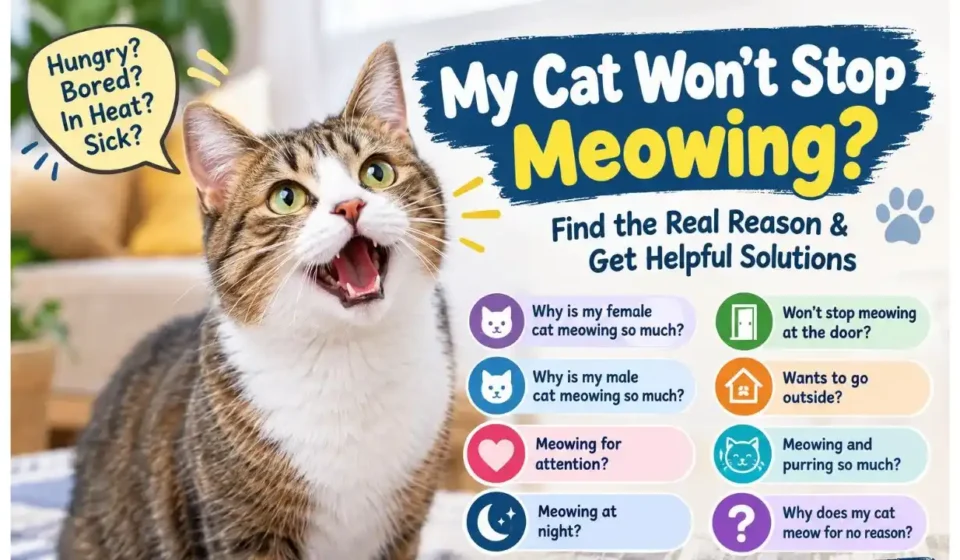

If you’re searching for “my cat wont stop meowing,” you’re probably wondering what your cat is trying to tell you. Cats meow to communicate with people, and an increase in vocalization can have many causes, from hunger and boredom to stress, attention-seeking, mating behavior, or an underlying health problem.
A cat that suddenly starts meowing much more than usual deserves attention, especially if the behavior is new. Understanding why your cat is meowing so much can help you respond appropriately and know when professional veterinary care is needed.
In this guide, we’ll explain the most common reasons cats meow excessively, including why cats meow at night, at doors, for attention, or when they want to go outside.

Why Wont My Cat Stop Meowing?
Cats meow for different reasons, and the meaning can depend on their age, personality, environment, and health.
Common reasons include:
- Hunger or thirst
- Wanting attention
- Boredom or loneliness
- Stress or anxiety
- Wanting to go outside
- Being in heat
- Pain or illness
- Confusion in older cats
- Changes in the home
- Wanting access to a closed room
- Seeking play or interaction
The first step is to consider what changed. If your cat has always been vocal, frequent meowing may simply be part of its personality. However, sudden excessive vocalization can sometimes indicate a medical or behavioral issue.
Why Is My Female Cat Meowing So Much All of a Sudden?
If your female cat suddenly becomes much more vocal, one possibility is that she is in heat, especially if she has not been spayed.
A female cat in heat may:
- Meow loudly and repeatedly
- Become unusually affectionate
- Rub against furniture or people
- Roll around on the floor
- Raise her hindquarters
- Try to escape outdoors
- Become restless
Heat-related vocalization can sound intense and may continue for several days.
If your female cat is spayed and suddenly begins meowing excessively, heat is less likely to be the explanation. In that situation, consider stress, environmental changes, pain, hunger, or another medical problem.
If the behavior is unusual for your cat, contacting your veterinarian is a good idea.
Why Is My Male Cat Meowing So Much All of a Sudden?
Male cats can also become extremely vocal, particularly if they detect a female cat in heat nearby.
An unneutered male may:
- Meow or yowl frequently
- Try to escape
- Become restless
- Spray urine
- Search for a mate
- Become more territorial
Even indoor male cats can react to cats outside the home. Your cat may smell or hear another animal through a window and become increasingly vocal.
Neutering can reduce mating-related behaviors, although it does not guarantee that every vocalization will disappear.
A sudden change in vocalization in a neutered male should also be evaluated in the context of his overall health and behavior.
Cat Won’t Stop Meowing for Attention
Some cats learn that meowing gets a response from their humans.
For example, if your cat meows and you immediately:
- Give treats
- Pet your cat
- Pick your cat up
- Open a door
- Start playing
- Give food
your cat may learn that meowing works.
This does not mean your cat is being “bad.” It simply means your cat has discovered an effective way to communicate with you.
How to Reduce Attention-Seeking Meowing
Try rewarding your cat when they are calm instead of immediately responding to repeated vocalization.
You can also provide:
- Interactive toys
- Daily play sessions
- Puzzle feeders
- Cat trees
- Window perches
- Regular feeding schedules
- Quality time with your cat
However, don’t ignore persistent meowing automatically. First make sure your cat’s basic needs are met and that there isn’t a medical reason for the behavior.
Why Is My Cat Meowing and Purring So Much All of a Sudden?
A cat that is meowing and purring may be happy and seeking interaction—but purring does not always mean a cat is completely comfortable.
Cats may purr when they are:
- Relaxed
- Seeking attention
- Hungry
- Excited
- Stressed
- Experiencing discomfort
Look at the entire body-language picture.
A relaxed cat may have soft eyes, a comfortable posture, relaxed ears, and a normal appetite.
A cat that is vocalizing while hiding, crouching, avoiding touch, eating less, or behaving unusually may need veterinary attention.
My Cat Keeps Meowing Loudly at Night
Nighttime meowing is a common problem for cat owners.
Cats are naturally most active around dawn and dusk. If your cat sleeps much of the day, they may have plenty of energy when you are trying to sleep.
Other possible causes include:
- Hunger
- Boredom
- Wanting attention
- Seeing animals outside
- Separation anxiety
- Medical problems
- Age-related confusion
How to Help a Cat That Meows at Night
Try increasing daytime activity.
A consistent evening routine can help:
- Have an interactive play session before bedtime.
- Feed your cat afterward if appropriate.
- Make sure fresh water is available.
- Clean the litter box.
- Provide a comfortable sleeping area.
- Reduce access to stimulating windows if outside animals trigger vocalization.
Avoid repeatedly rewarding nighttime meowing with food or play, because your cat may learn that waking you up produces a reward.
For older cats, persistent nighttime vocalization deserves particular attention because cognitive changes and medical conditions can contribute to nighttime confusion.
Why Does My Cat Keep Meowing for No Reason?
Cats generally have a reason for vocalizing, even when the reason isn’t obvious to us.
Your cat may be responding to something you haven’t noticed, such as:
- A sound outside
- Another animal
- A change in smell
- Hunger
- A dirty litter box
- Boredom
- Anxiety
- Pain
- Wanting access to a room
- Wanting attention
Try observing when and where the meowing happens.
Does your cat meow near the food bowl? At the bedroom door? Near a window? Around the litter box?
The location and timing can provide important clues.
My Cat Won’t Stop Meowing at the Door
If your cat repeatedly meows at a closed door, they may simply want access to whatever is on the other side.
Cats often dislike closed doors because they are naturally curious and territorial.
Your cat may be saying:
If the door leads outside, the behavior may be connected to outdoor stimulation.
If it is an interior door, try providing alternative enrichment nearby, such as a toy, cat tree, or comfortable resting area.
Don’t open the door every time your cat screams at it if you’re trying to reduce attention-seeking behavior. Instead, wait for a quiet moment and then provide access when appropriate.
My Cat Won’t Stop Meowing to Go Outside
Indoor cats may become persistent about going outside, especially if they previously had outdoor access.
Outdoor stimulation can be extremely rewarding because cats encounter:
- Birds
- Squirrels
- Insects
- New smells
- Other animals
- Moving objects
- New territory
However, allowing a cat to roam freely outdoors comes with risks, including traffic, predators, fights, parasites, infectious diseases, and getting lost.
If you want to provide outdoor enrichment, consider safer options such as a secure catio, supervised harness walks for suitable cats, or a protected outdoor enclosure.
Don’t Open the Door During a Meowing Fit
If your cat learns:
Meow → human opens door → outdoor access
they may become even more persistent.
Instead, when practical, wait for a calm moment before opening the door or providing another reward.
Common Reasons Your Cat Won’t Stop Meowing
| Situation | Possible Reason | What You Can Try |
|---|---|---|
| Meowing near food bowl | Hunger or learned behavior | Maintain a consistent feeding routine |
| Meowing at night | Boredom, hunger, anxiety, age-related changes | More daytime enrichment and an evening routine |
| Meowing at the door | Wants access | Reward calm behavior instead |
| Meowing to go outside | Outdoor stimulation | Try a catio or supervised outdoor time |
| Female suddenly vocal | Heat or health issue | Check spay status and consult a vet if unusual |
| Male suddenly vocal | Mating or territorial behavior | Consider neutering and reduce outdoor triggers |
| Meowing for attention | Learned behavior or loneliness | Increase structured interaction |
| Meowing with purring | Attention, excitement, comfort, or discomfort | Evaluate body language and other symptoms |
| Older cat meowing at night | Confusion or medical issue | Schedule a veterinary examination |
| Sudden unusual meowing | Possible illness or pain | Contact your veterinarian |
When Excessive Meowing May Mean Your Cat Is Sick
A sudden increase in vocalization should not always be treated as a behavioral problem.
Watch for other changes, including:
- Loss of appetite
- Increased thirst
- Frequent urination
- Difficulty urinating
- Vomiting
- Diarrhea
- Weight loss
- Hiding
- Limping
- Trouble jumping
- Changes in grooming
- Restlessness
- Aggression
- Lethargy
If your cat is crying out while appearing painful or distressed, contact a veterinarian.
Urinary Problems Can Be an Emergency
If a cat—particularly a male cat—is repeatedly going to the litter box, straining to urinate, crying, or producing little or no urine, seek veterinary care immediately.
A urinary blockage can become life-threatening and should not be managed at home.
How to Stop Excessive Meowing
The best approach depends on the cause.
1. Check Basic Needs
Make sure your cat has:
- Fresh water
- Appropriate food
- A clean litter box
- Comfortable resting areas
- Safe surroundings
2. Increase Enrichment
Bored cats may vocalize because they need something to do.
Try interactive toys, food puzzles, climbing structures, scratching posts, and regular play sessions.
3. Create a Routine
Cats often respond well to predictable routines.
Try keeping feeding, play, and bedtime activities relatively consistent.
4. Reward Quiet Behavior
When your cat is calm, offer attention or another appropriate reward.
This can help teach your cat that calm behavior also gets positive results.
5. Don’t Punish Your Cat
Yelling, hitting, spraying water, or frightening your cat can increase anxiety and may make the behavior worse.
Instead, identify the underlying reason and address it.
When Should You Call a Veterinarian?
Contact your veterinarian if your cat’s meowing is:
- Sudden and unusual
- Increasing over time
- Accompanied by appetite changes
- Associated with weight loss
- Accompanied by vomiting or diarrhea
- Associated with litter-box changes
- Accompanied by hiding or unusual aggression
- Associated with obvious pain
- Happening frequently in an older cat
Your veterinarian can perform an examination and determine whether an underlying medical problem could be contributing to the behavior.
F.A.Q. About Why won’t my cat stop meowing
1. Why won’t my cat stop meowing all of a sudden?
A sudden increase in meowing can be caused by hunger, attention-seeking, stress, environmental changes, mating behavior, or illness. If the change is unusual or accompanied by other symptoms, contact your veterinarian.
2. Why is my cat meowing loudly at night?
Cats may meow at night because they are active, bored, hungry, seeking attention, reacting to outdoor animals, or experiencing age-related confusion. Increasing daytime enrichment and establishing a consistent evening routine may help.
3. Why is my female cat suddenly meowing so much?
An unspayed female may become very vocal when she is in heat. If your female cat is spayed or the behavior is unusual, other behavioral or medical causes should be considered.
4. Why does my cat keep meowing at the door to go outside?
Your cat may be responding to interesting sights, sounds, smells, or other animals outside. A secure catio or supervised outdoor activity can provide enrichment without the risks associated with free roaming.
5. Should I worry if my cat suddenly starts meowing more?
Sometimes excessive meowing is harmless, but sudden vocalization can also indicate pain or illness. Pay attention to appetite, drinking, litter-box use, energy, movement, and other behavioral changes, and contact your veterinarian when something seems abnormal.
Conclusion: Why Wont My Cat Stop Meowing?
If you’re thinking, “my cat wont stop meowing,” don’t assume your cat is simply being difficult. Meowing is one of the main ways cats communicate with humans.
Your cat could be hungry, bored, lonely, stressed, interested in going outside, seeking attention, experiencing hormonal behavior, or trying to tell you that something doesn’t feel right.
Pay attention to when the meowing occurs, what happens immediately afterward, and whether your cat has any other behavioral or physical changes.
Most importantly, sudden or extreme vocalization, especially when accompanied by other symptoms, deserves veterinary attention. Understanding your cat’s individual behavior can help you respond appropriately while keeping your companion safe and comfortable.
Also read:-