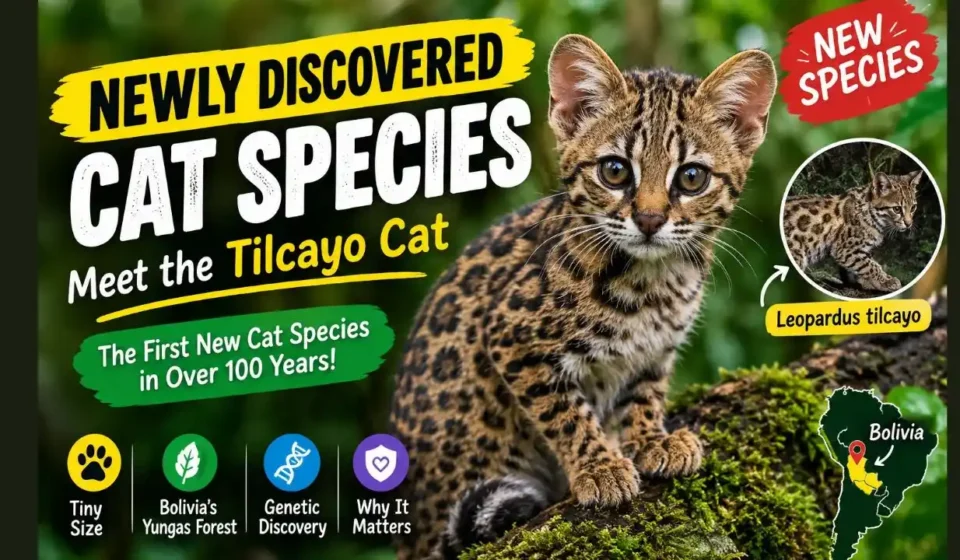
Newly Discovered Cat Species: Meet the Tilcayo Cat, the First New Cat Species in Over 100 Years

If you love cats, wildlife, and unusual animal discoveries, there is a remarkable new feline you should know about. Scientists have formally identified a new cat species called Leopardus tilcayo, commonly known as the Tilcayo cat.
The discovery was announced in September 2026 and is especially significant because researchers say it is the first newly described living cat species in more than 100 years. The tiny spotted feline was found in Bolivia’s Yungas cloud forest and was initially mistaken for a familiar small wild cat. Advanced genetic research eventually showed that it represents a distinct species.
For readers in the United States, the Tilcayo cat is a fascinating reminder that even in the modern age, scientists are still finding animals that have remained hidden in remote ecosystems.
What Is the Newly Discovered Cat Species?
The newly recognized cat is Leopardus tilcayo, also called the Tilcayo cat.
It belongs to the genus Leopardus, a group of small wild cats found mainly in Central and South America. Unlike lions, tigers, and other large cats, these smaller felines can be extremely difficult to study because they are secretive, live in dense forests, and often look remarkably similar to related species.
The Tilcayo is particularly interesting because scientists did not discover an obviously unknown animal wandering through the forest. Instead, researchers initially thought it belonged to an already recognized tiger-cat species.
Genetic analysis eventually revealed that the animal was different.
That makes this discovery especially important to modern wildlife science.
Meet the Tilcayo Cat
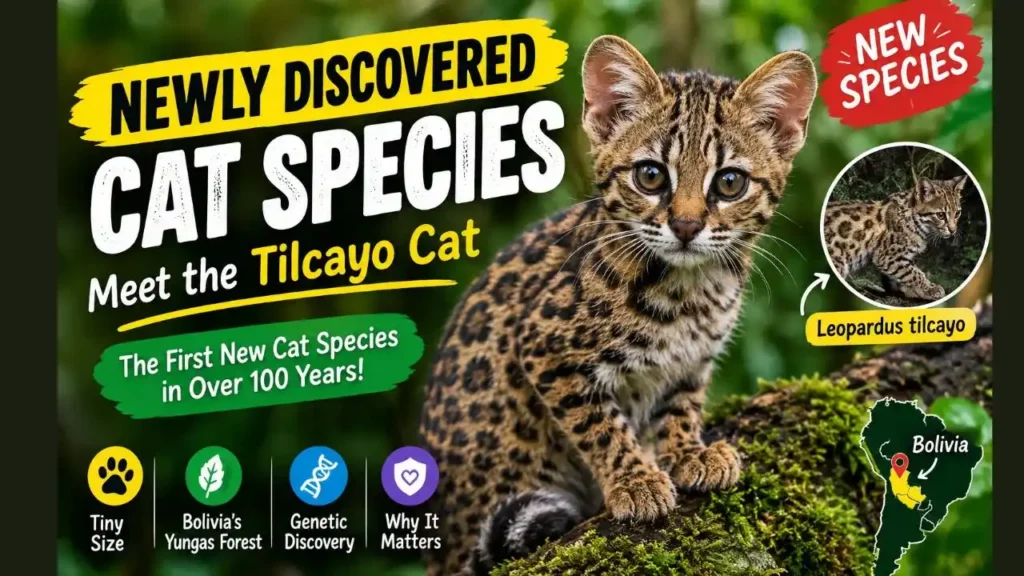
The Tilcayo cat is a very small wild feline with a spotted coat and a compact appearance.
The known individual is approximately 18 inches long from head to body and weighs around 3 pounds, making it considerably smaller than the typical American house cat. It has a light brown coat covered with dark, leopard-like rosettes.
Its appearance includes:
- Small body size
- Light brown fur
- Dark rosette-like markings
- Short, rounded ears
- Long whiskers
- Compact face
- Slender body
The combination of its size and markings makes the Tilcayo look somewhat like a miniature leopard.
Tilcayo Cat vs. Domestic Cat
A simple comparison helps explain just how unusual this animal is.
| Feature | Tilcayo Cat | Typical Domestic Cat |
|---|---|---|
| Scientific name | Leopardus tilcayo | Felis catus |
| Type | Wild cat | Domestic animal |
| Approximate weight | About 3 pounds | Often 8–10 pounds |
| Habitat | Bolivian Yungas forest | Homes and human environments |
| Coat | Brown with dark rosettes | Many colors and patterns |
| Behavior | Wild and secretive | Domesticated |
| Geographic range | Currently known from Bolivia’s Yungas region | Worldwide |
| Relationship with humans | Wild animal | Companion animal |
Where Was the New Cat Species Discovered?
The Tilcayo cat is associated with the Yungas forest region of Bolivia, on the eastern slopes of the Andes.
The Yungas is a mountainous, humid environment characterized by dense vegetation and cloud-covered forests. Such habitats can make wildlife research extremely challenging.
This is one reason a small mammal could remain scientifically unrecognized for so long.
Remote forests can contain species that are difficult to observe directly. A researcher might see a spotted cat and assume it belongs to a known species, especially when the animals have similar physical characteristics.
The Tilcayo discovery demonstrates why studying biodiversity in remote ecosystems remains important.
How Was the Tilcayo Cat Discovered?
The story of the Tilcayo cat is unusual.
Researchers first became interested in the animal after a small wild cat was brought to a wildlife sanctuary in Bolivia. According to National Geographic’s reporting, a local man had found the animal as a kitten near a forest and initially believed it was a domestic cat. After living with it for about a year, he recognized that the animal was wild and it eventually went to the Senda Verde wildlife sanctuary.
When biologist Paola Nogales-Ascarrunz examined the animal, she noticed several unusual characteristics.
The cat was very small, had distinctive facial features, and had striking leopard-like markings.
At first, however, scientists believed it might be a tiger cat that was already known to science.
That assumption changed when researchers examined its genetics.
Why Did Scientists Think It Was a Different Cat?
One of the biggest challenges in studying small wild cats is that appearance alone does not always tell the complete story.
Several Leopardus cats have similar:
- Spotted coats
- Small bodies
- Forest habitats
- Nocturnal habits
- Facial characteristics
A photograph or short observation may therefore not be enough to identify an individual correctly.
Researchers have spent years studying the tiger-cat group and have increasingly found that animals previously grouped together may actually represent different evolutionary lineages.
The Tilcayo is an especially striking example of this problem.
DNA Helped Confirm the New Cat Species
Modern genetics played a major role in identifying Leopardus tilcayo.
Researchers compared genetic information from 38 individuals across the Leopardus genus. The analysis showed that the Tilcayo was genetically distinct from the other tiger cats. Scientists estimated that its lineage diverged from its relatives roughly 1.4 million years ago.
This is why the discovery is more than simply finding a cat that looks unusual.
Scientists found evidence that the animal represents a separate evolutionary lineage.
Why DNA Matters
Two animals can look very similar but have significant genetic differences.
Genetic analysis can help researchers determine:
- Whether animals belong to the same species.
- How closely related different populations are.
- When evolutionary lineages separated.
- Whether previously recognized species may actually contain multiple species.
For small wild cats, this information can be particularly valuable because many species are difficult to distinguish in the field.
Is the Tilcayo Cat Really the First New Cat Species Discovered?
According to the researchers and reporting on the new study, yes, in the specific sense of a newly described living felid species, the Tilcayo represents the first such species formally described in more than a century.
The last newly described living feline species in this context was the pampas cat in 1923.
That makes the Tilcayo discovery an important milestone for cat research.
However, there is an important distinction.
Scientists have continued to reclassify and split existing cat groups as new genetic and taxonomic evidence became available. The Tilcayo is notable because it was not simply an old subspecies being renamed. Researchers identified it as a lineage previously unknown to science as a separate species.
The Tiger Cat Family Is More Complicated Than Scientists Thought
The discovery also changes scientists’ understanding of South America’s tiger cats.
Research indicates that what was once treated as a smaller number of tiger-cat species actually contains five distinct species under the new classification presented in the study.
This is an excellent example of how science changes when researchers obtain better evidence.
For many years, scientists relied heavily on:
- Physical appearance
- Museum specimens
- Geographic location
- Field observations
- Coat patterns
Today, researchers can combine these observations with genome-level data.
As a result, hidden differences can become visible.
What Does the Tilcayo Cat Eat?
There is still very limited information about the Tilcayo’s natural behavior.
Researchers know that the species is associated with the Yungas forest, but many basic questions remain unanswered. Scientists do not yet have a complete understanding of its diet, reproduction, population size, predators, or behavior in the wild.
Initial evidence suggests it is a small predator that may hunt small rodents.
Because researchers have so little information about the species, it would be premature to describe its entire diet or lifestyle with certainty.
More field research will be necessary.
Is the Tilcayo Cat Endangered?
Its conservation status is not yet fully established.
This is partly because scientists have only recently recognized the Tilcayo as a separate species. There is not enough information yet to confidently determine its total population, geographic range, or long-term population trend.
Researchers have shared their findings with the International Union for Conservation of Nature (IUCN) for consideration in future conservation assessments.
However, the broader Yungas ecosystem faces threats including:
- Deforestation
- Agricultural expansion
- Mining
- Habitat fragmentation
These threats make understanding and protecting small wild cats particularly important.
Why Is the Discovery Important?
The Tilcayo discovery matters for several reasons.
1. It Shows That New Mammal Species Can Still Be Found
Many people assume scientists have already discovered almost every large animal on Earth.
The Tilcayo challenges that assumption.
A small wild cat managed to remain scientifically unrecognized despite decades of wildlife research.
2. It Shows the Value of Genetic Research
Without genetic analysis, the Tilcayo might have continued to be classified as another tiger cat.
DNA technology allows scientists to investigate differences that cannot always be seen with the human eye.
3. It Highlights South America’s Biodiversity
South America contains an enormous variety of wildlife.
The Yungas forest is particularly important because its complex mountain environment can support species found nowhere else.
4. It Could Improve Conservation
You cannot effectively protect a species if you do not know that it exists.
Recognizing the Tilcayo as a distinct species gives conservation researchers a clearer target for future population studies and habitat protection.
How Many Cat Species Are There Now?
The exact number can depend on the taxonomic classification being used and how scientists treat recently split lineages.
The Tilcayo discovery is nevertheless significant because it adds a newly recognized living felid species to scientific understanding of the cat family. Researchers also identified another new subspecies in Peru as part of the same broader study.
Taxonomy is not always static.
As genetic research improves, scientists can discover that what was once considered one species actually consists of several distinct evolutionary groups.
So the cat family tree can continue to change.
Could There Be More New Cat Species?
Scientists involved in the research believe the methods used to identify the Tilcayo could help reveal additional hidden diversity among small wild cats.
This possibility is particularly interesting because small felines are often:
- Nocturnal
- Solitary
- Difficult to photograph
- Camouflaged
- Found in dense vegetation
- Similar in appearance to related species
A camera trap may capture an image of a spotted cat, but identifying its exact species can still be difficult.
Combining field observations with genetic information could reveal additional previously overlooked populations or species.
What Makes the Tilcayo Different From Other Wild Cats?
The Tilcayo’s combination of characteristics is what makes it stand out.
It is extremely small, has distinctive rosette patterns, and represents a genetically separate lineage. Its estimated evolutionary separation from related tiger cats also shows that its history goes back far beyond its recent scientific recognition.
In other words, the species is not new in an evolutionary sense.
It is new to formal scientific recognition.
The Tilcayo lineage has apparently existed for millions of years. Humans have only recently identified and described it as a distinct species.
Tilcayo Cat: What We Know and What We Don’t
| Question | What Scientists Currently Know |
|---|---|
| Scientific name | Leopardus tilcayo |
| Common name | Tilcayo cat |
| Location | Bolivia’s Yungas forest |
| Size | About 18 inches in body length for the known individual |
| Weight | Around 3 pounds |
| Appearance | Brown coat with dark rosettes |
| Type | Small wild cat |
| Genetic history | Diverged from related tiger cats about 1.4 million years ago |
| First formal description | 2026 |
| Diet | Limited information; small prey such as rodents is suspected |
| Conservation status | Still requires further assessment |
| Population | Unknown |
| Wild behavior | Poorly understood |
What This New Cat Species Means for Cat Lovers in the USA
For Americans who love domestic cats, the Tilcayo is a fascinating example of how different wild felines can be from pets.
Your house cat may spend its day sleeping on a couch, chasing toys, or asking for food. A wild cat such as the Tilcayo has evolved to survive in a completely different environment.
It is important not to confuse a wild species with an exotic pet.
The Tilcayo is a wild animal adapted to a specific forest ecosystem. Its discovery is valuable precisely because researchers are learning about it in its natural ecological context.
For pet owners, the biggest lesson is simple: wild cats should remain wild and be protected in their natural habitats.
The Future of Tilcayo Cat Research
Scientists still have many questions to answer.
Future research may investigate:
- Where the Tilcayo lives across the wider Yungas region
- How many individuals exist
- What it eats
- How it reproduces
- How large its territory is
- Which predators compete with it
- How habitat loss affects its population
- Whether additional populations exist elsewhere
Camera traps, genetic sampling, ecological surveys, and field observations could all contribute to this research.
The more scientists learn, the better they can understand the species’ conservation needs.
F.A.Q. About Newly Discovered Cat Species
– What is the newly discovered cat species?
The newly discovered cat species is called the Tilcayo cat, scientifically named Leopardus tilcayo. It is a small wild cat associated with Bolivia’s Yungas forest.
– When was the Tilcayo cat discovered?
The Tilcayo cat was formally described as a new species in 2026 after researchers used genetic and physical evidence to distinguish it from related tiger cats.
– Where does the Tilcayo cat live?
The Tilcayo cat is currently known from the Yungas region of Bolivia, a mountainous area containing humid forests and cloud forests.
– How big is the Tilcayo cat?
The known Tilcayo cat is very small, measuring about 18 inches in body length and weighing around 3 pounds. It is considerably smaller than most domestic cats.
– Is the Tilcayo cat endangered?
Its official conservation status is still being assessed because scientists have only recently recognized it as a separate species. Researchers need more information about its population, range, and threats before its conservation status can be fully determined.
Conclusion on the Newly Discovered Cat Species
The discovery of Leopardus tilcayo, the Tilcayo cat, is one of the most remarkable recent developments in feline science.
This tiny spotted wild cat from Bolivia’s Yungas forest demonstrates that nature still holds major surprises. Scientists initially believed the animal belonged to a known group of tiger cats, but genetic research revealed that it represents a distinct species with an evolutionary history stretching back approximately 1.4 million years.
The discovery is also a reminder that scientific knowledge is constantly developing. Even after centuries of studying the world’s cats, researchers can still uncover previously unrecognized branches of the feline family tree.
For now, much about the Tilcayo remains a mystery. Its population, behavior, diet, reproduction, and full geographic range require further research.
But one thing is already clear: the Tilcayo cat has given the world a new reason to look more closely at the hidden wildlife of South America’s forests.
And for cat lovers across the USA, this tiny wild feline is proof that the story of Earth’s cats is far from finished.
Also read:-



[…] Newly Discovered Cat Species: Meet the Tilcayo Cat, the First New Cat Species in Over 100 Years […]